

Why Hollywood Is Betting Big on Myth, Movie Stars, and Spectacle This Summer
There are summer blockbusters, and then there are movies that arrive carrying the weight of an event. Christopher Nolan’s The Odyssey belongs squarely in the second category.
On paper, it already has all the makings of a major cinematic moment: one of the most celebrated directors in modern filmmaking taking on one of the most enduring stories ever told, a cast stacked with some of the most recognizable actors in the world, a massive reported budget, and the kind of large-scale, globe-spanning production that only a handful of filmmakers can still get made in today’s Hollywood. But The Odyssey is bigger than a starry adaptation of Homer. It represents something else too: a renewed industry faith in spectacle with substance, in myth treated like blockbuster material, and in movie stars as part of the event again.
Christopher Nolan’s adaptation opens July 17 and stars Matt Damon as Odysseus, with Tom Holland, Anne Hathaway, Zendaya, Robert Pattinson, Lupita Nyong’o, Charlize Theron, Jon Bernthal, Benny Safdie, John Leguizamo, and Himesh Patel among the ensemble.
That matters because Hollywood has spent the last several years trying to answer a difficult question: what still gets audiences to leave the couch, buy the ticket, and show up for a theatrical experience that feels truly communal? Superheroes can still do it. Established franchises can still do it.
Horror can still do it. But Nolan has quietly become one of the few directors whose name itself can sell scale. With Oppenheimer, he proved that a dense historical drama could become a global event. With The Odyssey, he appears to be taking that trust and pushing it into even more ambitious territory: a mythic action epic rooted in ancient literature, but sold with the energy of a prestige blockbuster. And that is precisely what makes the film so interesting.
A Myth Reimagined as a Modern Event
At its core, The Odyssey follows Odysseus, the king of Ithaca, on his long and dangerous journey home after the Trojan War. It is one of the foundational stories in Western literature: a tale of war, grief, temptation, endurance, masculinity, marriage, fatherhood, gods, monsters, memory, and survival.
Odysseus is not a simple hero. He is brilliant, arrogant, strategic, flawed, emotionally complicated, and often morally slippery.

In other words, he is exactly the kind of protagonist Nolan tends to gravitate toward. Nolan has described Matt Damon’s take on Odysseus as closer to Han Solo than Luke Skywalker—less shining savior, more clever survivor, more man navigating chaos than man conquering it.
That distinction matters because it suggests Nolan is not interested in making a polished, museum-piece version of Homer. He is interested in a living, cinematic one—something visceral, muscular, and psychologically charged. This is not mythology as distant school text. It is mythology as action, obsession, spectacle, and emotional consequence.
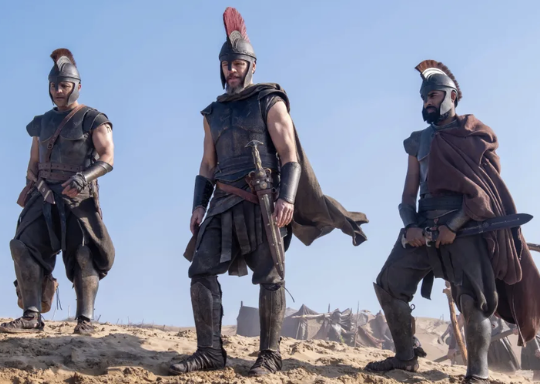
The trailer and early coverage already point in that direction. The film has been shot across Greece, Morocco, Italy, Scotland, Iceland, Malta, and Western Sahara, using cutting-edge IMAX production methods and the kind of practical-world filmmaking Nolan is known for. The scale appears enormous, but the promise is that the film will still feel tactile rather than digital, rooted in real landscapes, real physicality, and real danger.
The Cast Is the Conversation
Part of the heat around The Odyssey comes from the cast itself, which feels almost suspiciously stacked. Matt Damon leads as Odysseus, with Anne Hathaway as Penelope and Tom Holland as Telemachus, the son waiting for his father’s return. Zendaya plays Athena, the goddess guiding and protecting the journey, while Robert Pattinson takes on Antinous, one of Penelope’s most dangerous suitors.
Charlize Theron appears as Calypso, Jon Bernthal as Menelaus, Benny Safdie as Agamemnon, John Leguizamo as Eumaeus, and Himesh Patel as Eurylochus.

That ensemble does more than look good on a poster. It widens the film’s reach across audiences. Damon brings gravitas and old-school movie-star credibility. Holland and Zendaya bring an entire younger fan base that already sees them as one of the defining on-screen pairings of their generation, even if they don’t share scenes here. Hathaway and Theron bring glamour and dramatic authority. Pattinson brings unpredictability and edge. Together, they make The Odyssey feel less like a dusty literary adaptation and more like one of the year’s biggest pop-culture collisions.
And there is a very real argument that this is part of the strategy. The Odyssey is not just selling a famous story. It is selling a convergence: myth, prestige, star power, and Nolan’s brand of scale all in one package.
Tom Holland, Zendaya, and the Summer of the Big-Screen Couple
Even though The Odyssey is not being sold as a Tom-and-Zendaya vehicle, it would be naïve to pretend their presence doesn’t add another layer of heat.
The two are already central to another major franchise conversation through Spider-Man, and now they’re part of one of the summer’s most anticipated prestige releases too. That dual presence matters.
It turns them into part of the season’s larger movie-star narrative—a pair moving between blockbuster IP and auteur spectacle in a way Hollywood desperately wants from its younger stars.
There is also something smart about how Nolan appears to be using them. Rather than centering them in a conventional romance or youth-driven subplot, he’s folding them into a much larger, more classical story. It lets their fame help sell the film while also allowing them to stretch into something more mythic and elevated.
For Holland in particular, playing Telemachus positions him in a role that is emotional, restless, and narratively important without simply repeating the boyish superhero charm audiences already know. For Zendaya, Athena offers something rarer: grace, intelligence, power, and symbolism all in one role.

Why This Movie Matters to Hollywood
There’s a reason The Odyssey feels bigger than one release. It arrives at a moment when Hollywood is still trying to balance franchise fatigue with the need for event cinema. Studios want spectacle, but they also want legitimacy. They want big stars, but they also want critical respect. They want films that can dominate the culture for a weekend and still matter months later. Nolan has become one of the few filmmakers who can promise all of that at once.
That is why The Odyssey matters. It is not just another summer release. It is a test of whether audiences still have an appetite for large-scale original filmmaking rooted in something older, richer, and more ambitious than the usual formula. It is a reminder that myth can still feel modern when it is treated with scale, seriousness, and style. And it is proof that movie stardom still matters—especially when those stars are dropped into a story big enough to hold them.
THE VIVID TAKE
What makes The Odyssey so exciting is not simply that it looks expensive or prestigious or star-studded, though it is all of those things. It’s that the movie seems to understand what audiences are craving right now: scale, yes, but also meaning. Beauty, but also danger. Stars, but also story.
Christopher Nolan isn’t just adapting Homer. He’s trying to turn one of the oldest stories ever told into one of the defining movie events of the summer.
And if it works, The Odyssey won’t just be a hit. It will be a reminder that Hollywood still knows how to make mythology feel massive.
